
How does an electrochemical detector measure gas concentration?


An electrochemical detector measures gas concentration by allowing a target gas to reach a sensing electrode, where a chemical reaction produces an electrical current. The instrument measures that current and uses a calibration relationship to convert it into a concentration reading. For many toxic-gas sensors, a higher concentration produces a larger current within the sensor’s specified operating range.
That reading depends on more than the gas itself. The correct sensor chemistry, unobstructed gas access, suitable environmental conditions, and regular calibration all matter. Other gases can also affect the signal, so a displayed value is best understood as the instrument’s estimate of the target gas concentration under its operating conditions.
How an electrochemical detector turns gas into a reading
Inside the detector, the sensing element contains electrodes in contact with an electrolyte. The electrodes and electrolyte are selected to support reactions relevant to a particular gas. A gas-permeable opening allows the surrounding atmosphere to enter the sensor while helping control how quickly gas reaches the sensing electrode.
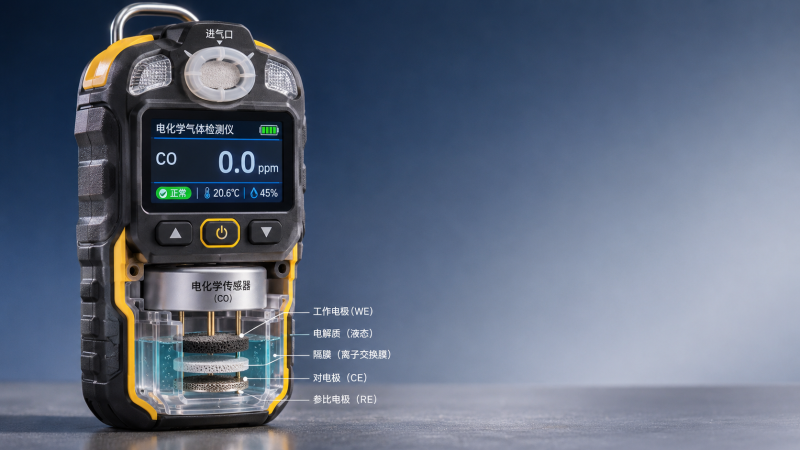
When a target gas such as carbon monoxide reaches the working electrode, it undergoes an oxidation or reduction reaction. This reaction involves a transfer of electrons. A corresponding reaction occurs at the counter electrode, allowing current to flow through the external circuit. Many designs also use a reference electrode to help the electronics maintain the working electrode at a suitable electrical potential.
The current is usually very small, so the detector’s electronics amplify and process it. The instrument then applies its calibration to display a concentration, often in parts per million for toxic gases. In an oxygen detector, the display commonly uses percent by volume instead.
The essential relationship is between the amount of gas reaching the electrode per unit of time and the resulting current. Under suitable conditions, and over the sensor’s specified measurement range, the current changes predictably with concentration. The instrument does not count individual gas molecules; it estimates concentration from the electrical response.
Why gas diffusion matters
Gas must pass through the sensor opening before it can react. In a diffusion-type detector, the concentration difference between the surrounding air and the sensor drives this movement. The sensor’s design controls the diffusion path so that the gas reaching the electrode produces a useful, repeatable response.
This also explains a practical limitation: the detector can measure only the atmosphere that reaches it. A blocked inlet, a poorly positioned detector, or a sampling line that absorbs the target gas can delay or reduce the response. A reading taken at one location does not automatically describe conditions elsewhere.
What happens when the target gas changes?
Electrochemical sensors are designed around particular reactions, so a detector configured for one gas cannot be assumed to measure another accurately. Carbon monoxide, hydrogen sulfide, and oxygen are common examples of gases measured with electrochemical sensing, but they require appropriate sensor chemistries and instrument configurations.
For carbon monoxide, the working electrode promotes oxidation of the gas, producing an electrical response related to its concentration. A hydrogen sulfide sensor uses a different chemistry suited to that gas. Oxygen sensors operate on oxygen reduction at an electrode; depending on the design, the cell may generate its own current rather than relying on the same electrode-control arrangement used by many toxic-gas sensors.
A gas detector’s label is therefore only a starting point. The sensor, its measurement range, and the instrument’s calibration must all match the gas and application. Two instruments may look similar while responding to different substances or concentration ranges.
How does the detector convert current into concentration?
The raw sensor current is not a concentration reading on its own. Electronics account for the sensor’s baseline signal and apply a calibration relationship established using known gas concentrations. If the response is linear across the relevant range, the instrument can use the relationship between current and concentration to estimate values between calibration points.
For example, imagine a detector that is correctly zeroed in suitable clean air and then exposed to a known concentration of its target gas. The instrument adjusts its response to match that reference. Later, when it encounters an unknown concentration within its operating range, it estimates the value from the measured current and the stored calibration.
Real sensors are not perfectly stable. Their baseline and sensitivity can change as the sensing materials age or as the sensor experiences environmental stress. Calibration corrects for changes that remain within the instrument’s adjustment capability; it cannot restore a damaged sensor or make an unsuitable sensor chemistry selective for a different gas.
Bump test versus calibration
A bump test exposes the detector to an appropriate test gas to check whether it responds and whether relevant alarms operate. It is a functional check, not a full measurement of accuracy across the operating range.
Calibration uses known conditions and reference gas to check and, where applicable, adjust the instrument’s reading. A detector can respond during a bump test yet still need calibration. Conversely, a recent calibration does not guarantee that the inlet has remained clear or that the alarm will work after the instrument has been used.
What can affect an electrochemical gas reading?
The reaction inside the sensor is only one part of the measurement. The path from the surrounding atmosphere to the display creates several opportunities for a reading to differ from the actual target-gas concentration.
Cross-sensitivity to other gases
Some gases other than the intended target can also react at the sensing electrode or otherwise influence the sensor response. This is called cross-sensitivity. Depending on the sensor and interfering gas, it can create a positive response or reduce the apparent target-gas reading.
Cross-sensitivity matters most when the surrounding atmosphere contains several gases. A carbon monoxide reading in a mixed industrial atmosphere, for example, should be interpreted with the specific sensor’s interference characteristics in mind. Filters and sensor chemistry can reduce certain interferences, but their effectiveness depends on the substances present and the sensor design.
Temperature and humidity
Temperature can affect reaction rates, gas diffusion, and electronic response. Humidity can influence the electrolyte and the movement of gas through the sensor. Instruments may compensate for some environmental effects, but compensation does not remove the need to operate within the specified conditions.
Rapid changes can be especially relevant when a portable detector moves between environments. The surrounding air and the sensor may not reach the same conditions immediately, so a changing reading may reflect both the atmosphere and the sensor’s adjustment to it.
Sensor age, exposure, and contamination
Electrochemical cells have a limited service life because their internal materials change over time. Exposure to unsuitable conditions, contaminants, or concentrations beyond the sensor’s intended range can also affect performance. A sensor may drift, respond more slowly, or fail to reach the expected value during a gas test.
If a reading seems implausible, the useful question is not simply whether the display is active. Consider whether the inlet is clear, the sensor is appropriate for the gas, calibration is current, and interfering substances or environmental changes are present. A failed gas check or persistent inability to calibrate points to an instrument that needs attention before its reading can support a decision.
Sampling location and response time
A detector needs time for gas to reach the sensor and for the electrical signal to stabilize. Sampling lines, filters, and pumps can add further delay. Some gases may also adhere to or react with materials in the sampling path, reducing the concentration that reaches the sensor.
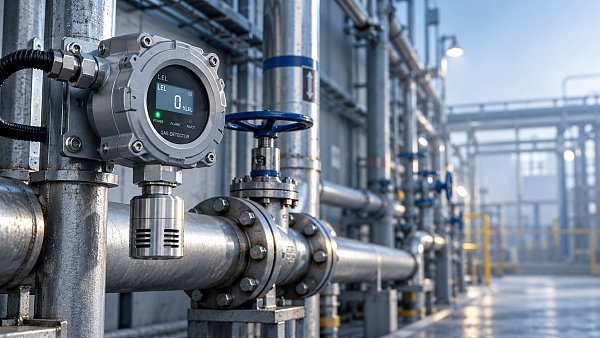
Position matters just as much. A detector placed away from a release, behind an obstruction, or outside the relevant airflow may show a low reading while a hazardous concentration exists elsewhere. Placement should reflect the gas, ventilation, potential release points, and the purpose of the measurement.
When is electrochemical sensing a good choice?
Electrochemical detection is useful when the target gas is known, a suitable sensor chemistry exists, and the expected concentration falls within the sensor’s range. It is commonly used for targeted toxic-gas and oxygen monitoring in portable instruments and fixed installations. Its electrical output also makes it practical to connect a sensor to a display, alarm, or control system.
The approach becomes less straightforward when the gas mixture contains strong interferents, conditions fall outside the sensor’s operating limits, or the measurement point is difficult to sample reliably. In those cases, the problem may require a different sensing technology, additional measurement channels, or a different sampling arrangement. No single gas-sensing principle is automatically suitable for every substance and atmosphere.
Oxygen monitoring illustrates why the application matters. An oxygen sensor can indicate oxygen deficiency or enrichment at its measurement location, but it does not identify every gas that may have displaced the oxygen. A normal oxygen reading alone does not establish that an atmosphere is free of toxic gases.
How to assess an electrochemical detector for a monitoring task
Start with the question the reading must answer. Identify the target gas, the concentrations of interest, and whether the instrument is intended for an individual spot check, continuous monitoring, or an alarm. A sensor optimized for one range may not provide useful resolution or protection across a much broader range.
Then consider the actual atmosphere. List the other gases likely to be present and compare them with the sensor’s cross-sensitivity information. Check whether temperature, humidity, pressure, and airflow fit the intended operating conditions. For sampled systems, include the entire gas path in the assessment: tubing material, length, filters, flow, and possible condensation can all influence the result.
Finally, consider how the instrument will remain dependable in use. Access to suitable test gas, routine functional checks, calibration, sensor replacement, and clear alarm behavior can be as consequential as the initial sensor specification. For a fixed installation, detector placement and alarm integration also need to reflect how a release could reach people or equipment.
An electrochemical detector provides a useful concentration estimate when the right gas reaches a suitable, properly maintained sensor. The most informative reading is one interpreted alongside the sensor’s range, possible interferences, sampling conditions, and the decision the measurement is meant to support.
Recommended for You
 How does an electrochemical detector measure gas concentration?Discover how an electrochemical detector measures gas concentration, what affects its accuracy, and how to choose and maintain the right sensor.
 How cross-interference affects electrochemical flue gas sensorsElectrochemical sensor cross-interference in flue gas can distort readings. Learn how to identify errors, assess sample conditions, and choose reliable solutions.
 How does sampling affect gas composition analysis accuracy?Gas Composition Analysis depends on representative sampling. Discover how probe placement, conditioning and transport affect accuracy, and what to verify before choosing a system.
 How does a CO analyzer control parking garage ventilation?Discover how a CO analyzer for parking garage ventilation controls fans, supports efficient airflow, and helps maintain a safer garage environment.
 How to choose a gas quality analyzer for natural gas pipelinesChoose the right gas quality analyzer for natural gas pipelines. Compare technologies, sampling systems and performance to support reliable decisions.
 How does pressure affect laser oxygen analyzer readings?Laser oxygen analyzer readings can shift with pressure. Learn how compensation, sample conditions and calibration affect accuracy—and how to troubleshoot changes.
 How to identify regulatory compliance requirements for your businessRegulatory Compliance starts with knowing which rules apply. Learn how to assess obligations, document decisions, and build effective controls for your business.
 How to choose industrial air monitors for workplace VOCsChoose industrial air monitors for workplace VOCs with confidence. Compare sensor technologies, placement, calibration, and safety requirements.
 Laser vs infrared gas analyzers for stack monitoring: Which handles water vapor interference better?Laser vs infrared gas analyzer stack monitoring: Discover which technology better handles water vapor interference and how to choose for your application.
 Can an air detector identify carbon monoxide indoors?Can an air detector identify carbon monoxide indoors? Learn which sensors detect CO, how to check device specifications, and why a certified alarm matters.
 How does a paramagnetic gas analyzer measure oxygen?Discover how a paramagnetic gas analyzer measures oxygen, what affects accuracy, and how to choose the right solution for your application.
 How to choose a reliable gas analyzer for low concentrationsChoose a reliable gas analyzer for low concentrations. Compare technologies, sampling, calibration and supplier evidence to make a confident purchase.
 How does cross-sensitivity affect multi gas analysis accuracy?Discover how cross-sensitivity affects multi gas analysis accuracy, and learn how to identify interference, validate compensation, and improve measurement reliability.
 How to choose metrics for sustainable monitoringSustainable Monitoring starts with metrics that drive action. Learn how to define boundaries, assess data quality, and track meaningful improvements.
 How to verify a trusted manufacturer's production capacityTrusted Manufacturer capacity claims need proof. Learn how to verify production plans, bottlenecks, quality records and supply risks before you place an order.
 How to choose an emission controller for an industrial boilerChoose the right emission controller for your industrial boiler. Compare technologies, operating conditions, compliance needs, and costs.
 How to choose composition analyzers for low-concentration measurementsChoose composition analyzers with confidence. Discover how quantification limits, sample handling and matrix effects shape reliable low-concentration measurements.
 How does online analysis compare with laboratory testing for water quality monitoring?Online analysis vs. laboratory testing: compare speed, accuracy, costs, and compliance to find the right water quality monitoring strategy.
 How to choose the right detection range for a custom gas analyzerChoose the right custom gas analyzer detection range with practical guidance on accuracy, exposure limits, calibration, and supplier evaluation.
 How does multi component monitoring detect gases in stack emissions?Discover how multi component monitoring detects stack gases, manages interference and supports reliable emissions reporting. Explore key CEMS selection factors.
 How bright should an industrial monitor be for outdoor use?Choosing an outdoor industrial monitor? Learn why 1,000 nits is a starting point and how glare, contrast, and heat affect sunlight readability.
 How does water vapor affect infrared gas analyzers?Infrared gas analyzers can be affected by humidity, condensation and spectral interference. Learn how to protect sample integrity and achieve reliable results.
 How to reduce customer support response timesReduce Customer Support response times with actionable tips for reporting equipment faults, choosing the right channel, and getting expert help faster.
 How to choose a low range analyzer for trace-level measurementsChoose the right low range analyzer for trace-level measurements. Compare detection limits, sampling, calibration and support to make a confident decision.
 How to choose combustible gas detectors for a specific gasChoose combustible gas detectors with confidence. Compare sensor technologies, gas response, calibration, placement, and certification for your application.
 How to choose an air quality analyzer for the pollutants you need to measureChoose an air quality analyzer with confidence. Compare pollutant measurement methods, sampling, accuracy and calibration to find the right fit for your needs.
 How to choose industrial metrology tools for tight tolerancesChoose industrial metrology tools for tight tolerances with confidence. Compare uncertainty, calibration, tool types, and costs to reduce inspection risk.
 How moisture affects fixed analyzer accuracy in stack gas monitoringImprove fixed analyzer accuracy in stack gas monitoring. Discover how moisture causes dilution, interference, and sample loss—and learn practical ways to protect emissions data.
 How does production line speed affect in-line measurement accuracy?Discover how production line speed affects in-line measurement accuracy. Explore sensor response, sampling, and timing to boost throughput without compromising quality.
 How condensation affects HCl concentration analyzer accuracyHCl concentration analyzer accuracy can suffer when condensation traps HCl. Learn how to spot sampling losses, prevent low readings, and improve measurement reliability.
 How does cross-interference affect multi-component gas analyzers?How does cross-interference affect multi component gas analyzers? Explore measurement errors, compensation limits, and validation tips to choose the right system for your process.
 How does temperature affect high-accuracy sensor performance?Explore how temperature affects high accuracy sensor performance. Learn to reduce thermal drift, evaluate compensation, and select the right sensor for reliable measurements.

Search Categories
Search Categories
- Smart Meters & Power Quality
- Transformer Gas Analyzers
- BESS Thermal Runaway Detectors
- Energy, Power & Smart Grid Monitoring
- Optical Profilers & CMM
- Ultrasonic & X-Ray NDT
- Calibration Standards
- Precision Metrology & NDT
- Water Quality Analyzers
- CEMS & VOCs Monitors
- Price Trends
- Import & Export Updates
- Market Trends
- Industry News
- Industry Insights
Latest Article
- How does an electrochemical detector measure gas concentration?Discover how an electrochemical detector measures gas concentration, what affects its accuracy, and how to choose and maintain the right sensor.Posted by:
- How cross-interference affects electrochemical flue gas sensorsElectrochemical sensor cross-interference in flue gas can distort readings. Learn how to identify errors, assess sample conditions, and choose reliable solutions.Posted by:
- How does sampling affect gas composition analysis accuracy?Gas Composition Analysis depends on representative sampling. Discover how probe placement, conditioning and transport affect accuracy, and what to verify before choosing a system.Posted by:
Please give us a message
