
How to select a hazardous gas analyzer for confined spaces


How to Select a Hazardous Gas Analyzer for Confined Spaces
Selecting a hazardous gas analyzer for confined spaces is not a routine equipment purchase. It is a decision that affects whether an entry supervisor receives a meaningful warning before a worker opens a manway, descends into a pit, or enters a vessel where the atmosphere has changed since the last reading.
The difficult part is that “confined space gas detection” is often treated as a generic requirement. In reality, the atmosphere inside a sewer, storage tank, utility vault, reactor, ship hold, or wastewater chamber can behave very differently. A detector that works well for a short maintenance check at the top of a dry valve pit may be inadequate for continuous monitoring during hot work in a solvent-contaminated vessel.
For quality-control and safety managers, the practical objective is simple: select an instrument that detects the actual hazards at the actual point of exposure, gives workers enough warning to act, and can be maintained well enough to remain trustworthy over time.
Start With the Space, Not the Instrument Catalogue
A confined space is rarely “one atmosphere.” Gas concentration can vary by height, temperature, ventilation pattern, process residue, and time since isolation. Hydrogen sulfide may settle or collect in low sections under certain conditions, while methane and other lighter-than-air gases may accumulate near the top. Carbon monoxide can appear during combustion-related work, and oxygen levels can fall because of oxidation, inerting, displacement by another gas, or biological activity.
This is why a procurement specification should begin with a task-based hazard review. Ask what was previously stored, processed, cleaned, welded, purged, or transported through the space. Consider nearby work as well. A vessel may be clean on paper, yet an adjacent line break, diesel-powered equipment, coating operation, or cleaning chemical can change the air quality quickly.
A reliable hazardous gas analyzer selection usually distinguishes between pre-entry testing and in-entry monitoring. Pre-entry testing often requires remote sampling with a pump and probe, especially when the atmosphere must be checked from outside the opening. In-entry monitoring may require a compact personal multi-gas detector with clear alarms, durable housing, and logging that supports permit and incident review. Some operations need both; trying to force one device into every role can create blind spots.
Define the Hazards the Analyzer Must Detect
The common four-gas configuration measures oxygen, combustible gas as a percentage of the lower explosive limit (LEL), carbon monoxide, and hydrogen sulfide. It is a sensible baseline for many industrial entries, but it is not a universal answer. The four-gas format does not identify every toxic contaminant, and an LEL reading does not tell the user exactly which flammable vapor is present.
For example, entries involving solvents, fuels, refrigerants, chlorine compounds, ammonia, sulfur dioxide, volatile organic compounds, or process-specific toxic gases may require additional sensors or a different measurement technology. The correct choice depends on the substances reasonably expected in the space, including contaminants created by the work itself.
Sensor selection deserves more attention than many buyers give it. Electrochemical sensors are widely used for oxygen and specific toxic gases. Catalytic-bead sensors are common for combustible-gas detection, while infrared sensors may be considered for particular hydrocarbon applications and can be less vulnerable to some forms of sensor poisoning. Neither approach is automatically better. Catalytic sensors require oxygen to detect combustible gas properly, while infrared sensors may not respond to hydrogen and have their own application limits. The supplier should explain the cross-sensitivities, expected interferents, operating limitations, and calibration gases for the intended use.
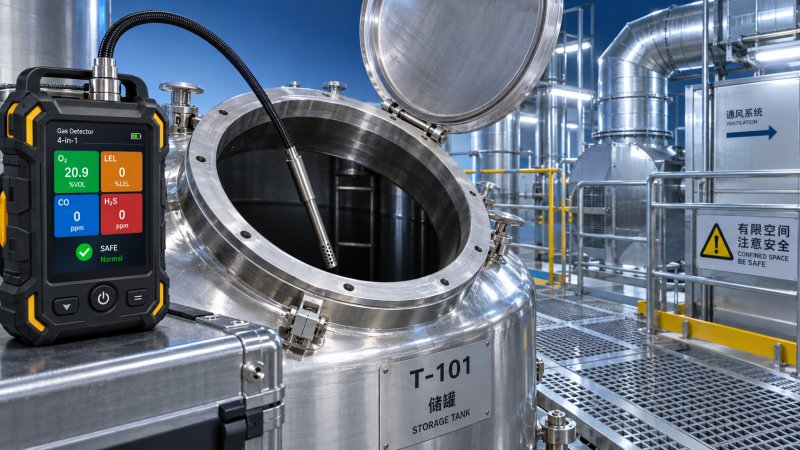
A useful question: what could make a “safe” reading misleading?
That question often reveals the real requirements. A sensor may show a low reading because the sample has not reached it yet, because a filter is blocked, because a vapor does not respond strongly to the sensor’s calibration gas, or because the sensor has been exposed to contaminants that affect performance. Inert atmospheres add another complication: combustible gas readings from certain technologies should never be interpreted without considering oxygen concentration and the device manufacturer’s instructions.
A hazardous gas analyzer is therefore not just a collection of sensors. It is a measurement system with sampling, response time, alarm logic, environmental constraints, maintenance requirements, and human factors.
Compare Performance Where It Matters in the Field
Datasheets can look similar until the instrument is used in a difficult location. Quality and safety teams should compare the parameters that affect decisions during an entry rather than focusing only on the number of gas channels.
Sampling time is especially easy to underestimate. When using a pumped unit and a long sampling hose, the gas must travel through the entire system before the reading can be relied upon. Some vapors can also be absorbed or delayed by unsuitable tubing. The manufacturer’s sampling guidance should be followed, but the procedure should also be tested in the organization’s actual configuration: pump, hose, probe, filters, and working environment.
Certification Is Necessary, but It Is Not the Whole Decision
Where a gas analyzer may be used in a potentially explosive atmosphere, equipment approval must match the jurisdiction and hazardous-area classification. Depending on the market and site, buyers may need to review ATEX, IECEx, UL, CSA, UKCA-related requirements, or other applicable schemes. The procurement team should not assume that a familiar logo means the instrument is suitable for every zone, division, gas group, temperature class, or country of use.
There is also a difference between explosion protection certification and gas-measurement performance. A device may be approved for use in a hazardous location while still being poorly matched to the gases, ranges, response expectations, or sampling method required by the job. Both sides of the specification matter.
Local confined-space regulations and permit procedures should guide alarm thresholds, testing sequence, training, and documentation. In the United States, OSHA requirements are frequently referenced for permit-required confined spaces; elsewhere, national rules and site standards may differ. For multinational operations, it is safer to build a core technical specification and then validate each deployment against local legal and site requirements.
Treat Calibration and Bump Testing as Part of the Purchase
Many gas detector programs fail after the purchase order is closed. Instruments get stored in vehicles, loaned across departments, charged inconsistently, exposed to harsh conditions, and returned without a clear record of whether they passed a functional test. A premium analyzer with no workable maintenance process is less useful than a simpler model that the team can test, calibrate, document, and repair reliably.
A bump test checks whether the instrument responds to a known gas and activates its alarms. Calibration adjusts the instrument against a known standard according to the manufacturer’s procedure. They are not interchangeable. The exact frequency should follow manufacturer guidance, the site’s risk assessment, applicable regulations, and the device’s exposure history. After an impact, abnormal reading, failed test, suspected contamination, or extended storage, the instrument may require additional attention before use.
Before selecting a hazardous gas analyzer, calculate the operating burden: calibration gas availability, regulators, docking or test stations, replacement sensors, battery service, repairs, firmware support, and local technical service. If the analyzer will be deployed across several countries, verify where consumables can be sourced and whether calibration records can be managed consistently.
Do Not Ignore the Worker Interface
The person entering the space may be wearing gloves, a harness, protective clothing, hearing protection, and a respirator. Small usability details become safety details: a screen that cannot be read in direct light, buttons that cannot be operated with gloves, a clip that catches on a harness, or an alarm that disappears under machinery noise.
For team entries, consider how readings will be communicated to the attendant and entry supervisor. A personal monitor alone may be appropriate for some tasks. Other jobs benefit from a portable area monitor, remote visibility, or data transmission—provided that wireless features are evaluated realistically for coverage, battery life, cybersecurity, and site rules. Remote data should support competent decisions, not encourage supervisors to rely on a screen while ignoring communication and rescue procedures.
A Practical Procurement Review
Before approving a model, ask suppliers to demonstrate the proposed configuration against the actual work scope. The review should include the target gases, expected concentration range, possible interferents, sensor limitations, alarm settings, sample draw method, certifications, calibration process, service lead time, and data export capability. Request the manuals and certificates early rather than relying on a sales quotation summary.
It is also worth involving the people who will own the instrument after commissioning: safety managers, maintenance technicians, quality personnel, confined-space supervisors, and procurement. They will spot different risks. The safety team may focus on alarms and procedures; maintenance will care about charging, repairs, and spare parts; quality teams may need defensible records and controlled calibration practices.
At Global Instrument Hub, equipment comparisons are most useful when they connect instrument specifications with the full operating context—process conditions, metrology expectations, hazardous-area requirements, supplier support, and long-term maintenance capacity. That approach matters because the lowest purchase price can be misleading when calibration logistics or unsuitable sensors later disrupt the confined-space program.
The right analyzer is the one that workers can use correctly, supervisors can trust, and the organization can maintain without shortcuts. If the intended atmosphere, sampling method, and support model are clear before purchase, the final selection is usually far more defensible than choosing the most feature-heavy detector on the list.
Recommended for You
 How to choose the right detection range for a custom gas analyzerChoose the right custom gas analyzer detection range with practical guidance on accuracy, exposure limits, calibration, and supplier evaluation.
 How does multi component monitoring detect gases in stack emissions?Discover how multi component monitoring detects stack gases, manages interference and supports reliable emissions reporting. Explore key CEMS selection factors.
 How bright should an industrial monitor be for outdoor use?Choosing an outdoor industrial monitor? Learn why 1,000 nits is a starting point and how glare, contrast, and heat affect sunlight readability.
 How does water vapor affect infrared gas analyzers?Infrared gas analyzers can be affected by humidity, condensation and spectral interference. Learn how to protect sample integrity and achieve reliable results.
 How to reduce customer support response timesReduce Customer Support response times with actionable tips for reporting equipment faults, choosing the right channel, and getting expert help faster.
 How to choose a low range analyzer for trace-level measurementsChoose the right low range analyzer for trace-level measurements. Compare detection limits, sampling, calibration and support to make a confident decision.
 How to choose combustible gas detectors for a specific gasChoose combustible gas detectors with confidence. Compare sensor technologies, gas response, calibration, placement, and certification for your application.
 How to choose an air quality analyzer for the pollutants you need to measureChoose an air quality analyzer with confidence. Compare pollutant measurement methods, sampling, accuracy and calibration to find the right fit for your needs.
 How to choose industrial metrology tools for tight tolerancesChoose industrial metrology tools for tight tolerances with confidence. Compare uncertainty, calibration, tool types, and costs to reduce inspection risk.
 How moisture affects fixed analyzer accuracy in stack gas monitoringImprove fixed analyzer accuracy in stack gas monitoring. Discover how moisture causes dilution, interference, and sample loss—and learn practical ways to protect emissions data.
 How does production line speed affect in-line measurement accuracy?Discover how production line speed affects in-line measurement accuracy. Explore sensor response, sampling, and timing to boost throughput without compromising quality.
 How condensation affects HCl concentration analyzer accuracyHCl concentration analyzer accuracy can suffer when condensation traps HCl. Learn how to spot sampling losses, prevent low readings, and improve measurement reliability.
 How does cross-interference affect multi-component gas analyzers?How does cross-interference affect multi component gas analyzers? Explore measurement errors, compensation limits, and validation tips to choose the right system for your process.
 How does temperature affect high-accuracy sensor performance?Explore how temperature affects high accuracy sensor performance. Learn to reduce thermal drift, evaluate compensation, and select the right sensor for reliable measurements.
 Can a C4H8O concentration analyzer distinguish between isomers?Can a C4H8O concentration analyzer distinguish isomers? Compare GC, FTIR and MS methods, uncover selectivity limits, and learn what to validate before choosing your instrument.
 How to identify a reliable supplier using on-time delivery recordsIdentify a Reliable Supplier by verifying on-time delivery records, original commitments, and complete shipments. Learn practical checks to reduce purchasing risk and protect your project schedule.
 How sensitive should a portable hydrogen analyzer be for lab use?Choose a portable hydrogen analyzer for laboratory use with the right quantification limit, accuracy, and range. Learn how to verify performance and avoid costly buying mistakes.
 How to set industrial calibration intervals based on equipment riskSet industrial calibration intervals based on equipment risk, drift, and as-found data. Learn when to shorten or extend schedules to improve reliability and avoid unnecessary costs.
 How to choose electrochemical analyzers for low-current measurementsCompare electrochemical analyzers for precise low-current measurements. Learn how noise, leakage, bandwidth, and real-cell testing help you choose the right instrument.
 What tolerance does a custom gas mixture need for calibration?Choose the right custom gas tolerance for calibration. Learn how blending tolerance, certified uncertainty, and stability affect accuracy—and avoid paying for precision you don’t need.
 How condensation affects stack detector readings in wet flue gasStack detector readings can drift when wet flue gas condenses. Learn how to identify moisture interference, prevent sample losses, and improve emissions monitoring reliability.
 How to prevent condensation in a CO2 analyzer sampling systemPrevent condensation in your CO2 analyzer sampling system. Learn how to control dew point, eliminate cold spots, and manage moisture for reliable readings and fewer costly disruptions.
 How to verify accuracy claims for industrial quality analyzersVerify accuracy claims for industrial quality analyzers with calibration checks, independent testing, and clear acceptance criteria. Learn how to reduce risk and buy with confidence.
 How to calculate cooling loads for an industrial analyzer shelterSize industrial analyzer shelter cooling with confidence. Learn to calculate equipment heat, solar gains, and ventilation loads, then select HVAC capacity for reliable analyzer performance.
 Hydrogen Analyzers for Energy Storage: Purity Monitoring vs. Leak DetectionChoosing a hydrogen analyzer for energy storage systems? Compare purity monitoring and leak detection to select the right sensors, improve safety, and protect fuel cell performance.
 NH3 Monitoring in Fertilizer Plants: Where Should Leak Analyzers Be Installed?NH3 analyzer for fertilizer production: discover where to place leak detectors around storage, compressors, and loading areas to reduce blind spots and improve early warning.
 Diesel Engine NOx Analyzers: Response Time and NO2 Conversion ExplainedChoosing a NOX analyzer for diesel engines? Learn how response time, NO2 conversion, and sampling design affect accuracy—and make a smarter, evidence-based purchase.
 SO2 Analyzers for Smelter Emissions: Sampling Hot, Dust-Laden Flue GasSelect an SO2 analyzer for smelting industry applications. Discover how to handle hot, dust-laden flue gas, prevent sample losses, and achieve reliable emissions monitoring.
 Unstable CH4 Readings in Biogas Monitoring? Check Moisture and Sample FlowCH4 analyzer for biogas monitoring giving unstable readings? Discover how moisture, sample flow, and pressure checks help pinpoint faults and restore reliable methane measurements.
 Buying a CO2 Analyzer for Brewery Gas Recovery: Costs Beyond the Purchase PriceBuying a CO2 analyzer for brewery applications? Compare sampling, installation, calibration, and downtime costs to uncover hidden expenses and make a smarter gas recovery investment.
 Where to Place CO Analyzers for Effective Parking Garage VentilationOptimize your CO analyzer for parking garage ventilation with practical placement tips. Learn how sensor height, airflow, and zone coverage support timely detection and effective fan control.
 NDIR vs. FTIR Gas Analyzers: Which Fits Your Environmental Research?Find the right infrared gas analyzer for environmental research. Compare NDIR vs. FTIR on sensitivity, gas coverage, sampling needs, and cost to choose confidently for your study.





Search Categories
Search Categories
- Smart Meters & Power Quality
- Transformer Gas Analyzers
- BESS Thermal Runaway Detectors
- Energy, Power & Smart Grid Monitoring
- Optical Profilers & CMM
- Ultrasonic & X-Ray NDT
- Calibration Standards
- Precision Metrology & NDT
- Water Quality Analyzers
- CEMS & VOCs Monitors
- Price Trends
- Import & Export Updates
- Market Trends
- Industry News
- Industry Insights
Latest Article
- How to choose the right detection range for a custom gas analyzerChoose the right custom gas analyzer detection range with practical guidance on accuracy, exposure limits, calibration, and supplier evaluation.Posted by:
- How does multi component monitoring detect gases in stack emissions?Discover how multi component monitoring detects stack gases, manages interference and supports reliable emissions reporting. Explore key CEMS selection factors.Posted by:
- How bright should an industrial monitor be for outdoor use?Choosing an outdoor industrial monitor? Learn why 1,000 nits is a starting point and how glare, contrast, and heat affect sunlight readability.Posted by:
Please give us a message
